

A stock pitch is where everything you know about a company has to fit into a few clear minutes. It is the centrepiece of most equity research interviews and a real test of whether you can think, not just recite. The good news is that a strong pitch follows a structure you can learn. Here is how to build your first, with a worked Indian example to show it in action.
Before we start, one honest note: the example below uses a familiar Indian sector purely to demonstrate the method. It is a teaching illustration of how a pitch is built, not a recommendation to buy or sell any stock, and every figure in it is illustrative. With that clear, let us build a pitch from scratch.
What a stock pitch is meant to do
A pitch is not a company summary; it is a recommendation. Its job is to convince a listener, in a few minutes, that a stock is mispriced and that you have a clear, defensible view on which way. The whole point is to take a stand: buy, sell, or hold, and back it. A pitch that simply describes a company without a view is the most common beginner mistake. Remember what you are really doing: making an argument, then defending it.
The structure that lands in minutes
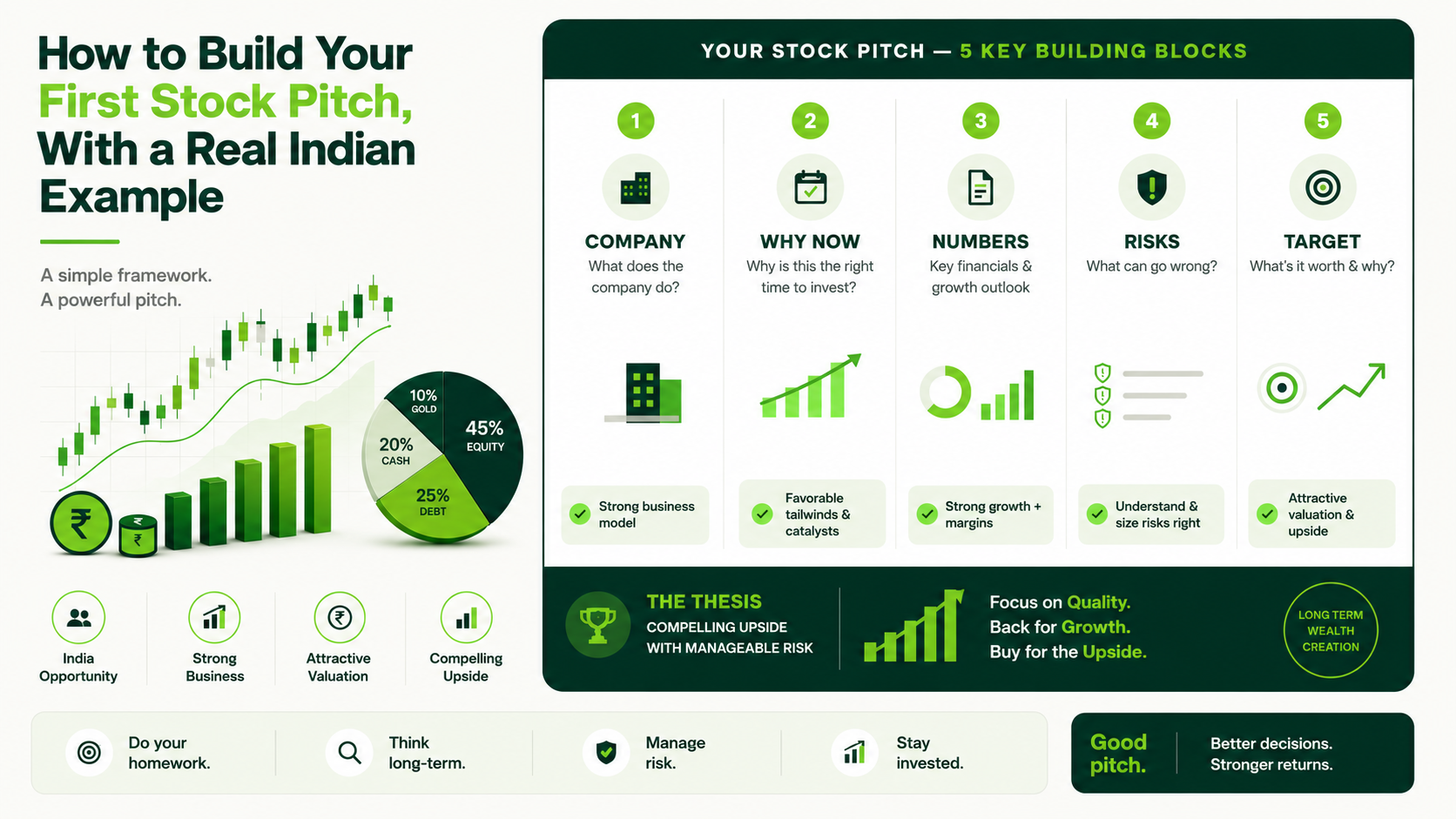
A pitch that works has a clear shape. Open with your recommendation and a one-line thesis, so the listener knows your view immediately. Follow with the two or three reasons that support it, the real drivers. Then give your valuation and a rough sense of the upside. Finish with the key risks and why you still hold your view. Recommendation, thesis, drivers, valuation, risks: that order respects the listener's time and signals that you can prioritise what matters. Bury the view at the end and you lose the room.
A worked Indian example, step by step
Picture a large, well-known Indian paints company, used here purely to illustrate the method. You would open like this: I would buy this stock, because the market is underrating how durable its pricing power and market leadership are as raw-material costs ease. Then the drivers: a dominant distribution network rivals cannot easily replicate, margins set to recover as input costs fall, and steady demand from a growing housing and renovation market. Notice how each driver is a reason the market may be wrong, not just a fact about the company. That is the difference between a pitch and a profile.
Valuation and the one-line thesis
Valuation turns the story into a number. For an illustration, you might say the stock trades at a certain multiple of earnings, and if margins recover as you expect, earnings rise and the stock looks cheaper than the headline suggests, supporting upside to a target you can defend. Keep the maths simple and the assumptions explicit; an interviewer cares far more about your reasoning than a precise figure. Then compress it all into one line, the thesis: a market leader whose margin recovery the market is underpricing. If you can say your thesis in a sentence, you understand it. If you cannot, you do not yet.
Delivering it under questioning
The pitch is only half the test; defending it is the other half. Expect pushback: what if input costs do not fall, what if a competitor takes share, what if demand slows. A strong candidate has already thought about these and answers calmly, conceding what is genuinely uncertain while explaining why the core view still holds. Do not get defensive or abandon your view at the first challenge; that signals you never really believed it. Hold your ground where the evidence supports you, and concede gracefully where it does not. That balance is exactly what the exercise is testing, and walking you through building and defending a real pitch under that pressure is exactly what our applied teaching at Fin Maverick is built around.
Build your first pitch
Put the structure to work on one company this week:
- Pick one listed company you genuinely understand.
- Decide your view: buy, sell, or hold, and why the market may be wrong.
- Write your thesis in a single sentence.
- List two or three real drivers and a simple valuation.
- Prepare answers to the three hardest questions against your view.
Frequently asked questions
How do you build a stock pitch?
Open with a clear thesis, support it with valuation and catalysts, then state risks and a target.
What should a stock pitch include?
A thesis, the key drivers, valuation, risks, and a recommendation with a target.
How long should a stock pitch be?
Short and tight, often a few minutes spoken or one page written.
Do I need a model for a pitch?
A simple supporting model helps, but the thesis carries the pitch.